Performance A. Front Squat
x5x3 @ 60% rest :30 (:03 pause in bottom position)
x3x3 @ 70-80% Rest :60
x1-2×6 @ 85%+ Rest 2:00
*Try to set a new PR, Best weight recorded
B. Tabatas (8 rounds :20 on / :10 off)
Thrusters @ 45 lb, 35 lb
rest 1:00
Russian Swings @ 24K, 16K
rest 1:00
Row for Cals
*Total reps and cals recorded
C. 3 Rounds
:60 Front Plank
10 Scap Pull-up
Foundations Skill Snatch
A. Snatch 5×3
3 Rounds (w/ Barbel, UB Weight)
5 Front Squats
5 Push Press
5 Back Squats
400m Run
“Patience, persistence and perspiration make an unbeatable combination for success.” – Napoleon Hill
Thanks to all that donated to the Brittany Tuck Memorial scholarship Fund we raised just over $800!
50-40-30-20 and 10 rep rounds of:
Wall Ball @ 20 lb, 14 lb
Power Clean @ 95 lb, 65 lb
Pull-ups
*Teams of 2-3 split reps, must finish all reps before moving on to the next exercise
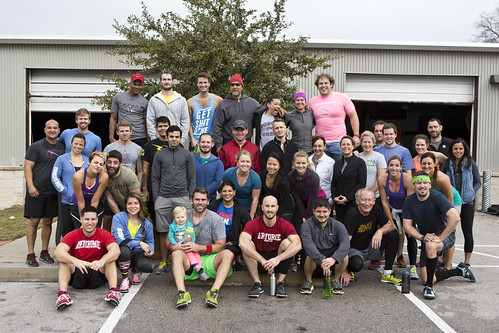
Work hard to play harder; that’s the motto around these parts. There’s nothing like a new year, new goals and a little motivation to get the train headed straight to Awesomeville. So, for the 5th straight year, CrossFit Austin proudly presents The Circle of Awesomeness Challenge.
Look good. Feel good. Play good. Let’s Go.
What is it?
The COA challenge is a trifecta of awesomeness: Part fitness, part nutritional and body composition, and part accountability. Our goals for each 2014 Circle of Awesomeness Challenger are:
Mental and emotional preparation for the longevity of a healthy lifestyle
Creation of lasting habits for individualized nutritional and body composition success
Fitness Challenges:
Athletes will be tested and retested in 3 different fitness categories. Each category is comprised of 2-3 tests, for a total of 8 tests.
The categories are:
Work Capacity
Strength
Athleticism
**These fitness tests will be the Workout of the Day, as an “All Levels” Group Class during the first and last week of the challenge. Thus, testing will occur during your scheduled WOD. Just like the CrossFit Open, athletes will partner up and judge each other during WOD’s . Athletes and judges will sign off on their score sheets before turning them into the coach. There will be 3 divisions of the COA Challenge: D1 (Rx), D2 (scaled level 1), D3 (scaled level 2) – all levels of CFA athletes are encouraged to participate in the Circle of Awesomeness Challenge.
Nutritional and Body Composition Challenges:
Challengers will be tested and retested on body composition and weight, for their own information. Throughout the Challenge, Challengers will receive points for completing weekly nutritional and lifestyle challenges and assignments. Challengers will also receive points for attending weekly accountability and educational seminars.
Important Dates
January 18th @11:00 am – Kick-Off Seminar Saturdays {Jan. 25, Feb. 01, 08, 15, 22 @ 11:00 am} -Accountability and Educational Seminars January 20th – January 25th Initial Fitness Tests Monday 1/20 – Tests 1, 2 Tuesday 1/21 – Tests 3, 4 Wednesday 1/22 – Make up day Thursday 1/23 – Tests 5, 6 Friday 1/24 – Make up day Saturday 1/25 – Tests 7, 8 February 24th – March 1st Final Fitness Tests Monday 2/24 – Tests 1, 2 Tuesday 2/25 – Tests 3, 4 Wednesday 2/26 – Make up day Thursday 2/27 – Tests 5, 6 Friday 2/28 – Make up day Saturday 3/1 – Test 7 & 8 Saturday, March 8th – BBQ Potluck & Awards Ceremony
What’s in it for you?
There will be 3 divisions of the COA Challenge D1 (Rx), D2 (scaled L1) and D2 (scaled L2). Each Division will produce one Male and one Female winner. This challenge will be unique to each participant as our primary focus will be on goal setting and assisting each challenger in achieving their goals.
What you can win:
1st Place Male & Female per division (6 total): $100 cash prize + 1 month of FREE group class membership
Most Improved Male and Female Fitness Performances (2 total): Reebok Nano or Oly shoes of choice
Top Male and Female Fitness Performances per division (6 total): Complimentary entry into this year’s CrossFit Open + Free CFA T-Shirt
100% Accountable: CrossFit Austin T-Shirt
What you get:
A Kick-off “Success Seminar” with the CrossFit Austin coaching staff: Saturday January 18th @ 11:00 am.
2 Body Composition Assessments: Assessment includes Measurements, Body Fat Percentage, and BMI, conducted by your CrossFit Austin Coach/Team Lead. Initial assessment occurs during the 1st week of the challenge, the final assessment is during the last week of the challenge.
An official CrossFit Austin Nutritional Guide: Complete with foods to avoid, shopping guides, healthy recipes, supportive educational materials and feedback.
Before and After Photos: Not required, but highly recommended!
Comprehensive Fitness Tests: Tests will cover Work Capacity, Strength, and Athleticism in the competition division you select (Rx, D1, D2).
Weekly Accountability & Educational Seminars: Each week will include a new focus and topic. These seminars are designed to give you the tools for lasting success and help you stay accountable throughout the process. Classes will meet every Saturday from January 18th – February 22nd at 11:00am.
**Bonus** Spouses or significant others will be allowed to attend these seminars for free.
Challenger Facebook Page: A private Facebook Page, monitored by the CrossFit Austin Staff, will be updated tri-weekly with a relevant, educational article. The page will be a phenomenal forum for questions, to share success, struggles, articles, recipes and ideas! This has been a huge success factor in many folks’ experience in past years!
Weekly Video Skill Progressions: On topics such as Movement Quality, Mobility, Stretching and Recovery Methods
Support: Challengers will be assigned to a CrossFit Austin Coach as their Team Lead. Over the course of the 6 week challenge, each athlete will receive support, accountability feedback, goal specific feedback and motivation – not to mention have LOADS of fun!
Pricing
Open Registration: 12/30 – 01/10 = $100 *Enter code “openregistration” for discount Last-Minute Pricing:01/11 – 01/17 = $125 *No code for last-minute pricing *Space is limited to 60 Challengers only!*
Below are the fitness challenge details for the Circle of Awesomeness 2014. Please review each item and description along with the division specs. There are three fitness challenge divisions: Rx, D1, D2. The division you select will be the division you participate in throughout the entire challenge. We look forward to obtaining your division information on Saturday, January 18th during the Kick-Off Seminar!
Monday – {Pre-Test: 01.20 || Post-Test: 02.24}
A. 1 RM Power Clean in 15:00
B. 3:00 Max Meter Row
Description:
Power Clean
Athlete’s will start with an empty barbell and build to a 1 rep max in the power clean. All lifts must be started and completed within the 15:00 time span. Athletes will be grouped together in groups of 2-3 and must work together
Row
Each athletes will have 3 minutes to row for max meters. Male dampers will be set at 6, Female dampers will be set at 4.
Division Options Rx: As listed D1: As listed D2: As listed
Tuesday- {Pre-Test: 01.21 || Post-Test: 02.25} CrossFit Total Find a 1 rep max in the Press, Back Squat, and Deadlift
Description:
Athletes will be expected to warm up before class time. As soon as class starts we will begin with the press. The athlete’s will have 20 minutes to find a 1 rep max in each exercise, in the following order:
1. Press
2. Back Squat
3. Deadlift
Coaches must view the max attempts and approve that full range of motion is met. All athletes will be place in groups of 2-3 athletes per station.
Division Options Rx: As listed D1: As listed D2: As listed
Thursday- {Pre-Test: 01.23 || Post-Test: 02.27}
1:00 Max Double Unders
5:00 AMRAP
5 Thrusters
5 No Push Up Bar Jump Over Burpees
*Total reps recorded
Description:
1:00 Max Double Unders
Each athlete will have 1:00 to complete as many double unders as possible. Athletes will be placed in two heats and will judge/count each others performance.
Each athlete will have 5:00 minutes to complete as many repetitions as possible. The athlete will perform all 5 Thrusters, followed by all 5 no push up over the bar burpees. Athletes will be placed in two heats and will judge/count each others performance.
Division Options Rx: M – 135 lb, W – 95 lbs D1: M – 95 lb, W – 65 lbs D2: M – 75 lb, W – 45 lbs
Saturday- {Pre-Test: 01.25 || Post-Test: 03.01}
“Cindy”
20:00 AMRAP
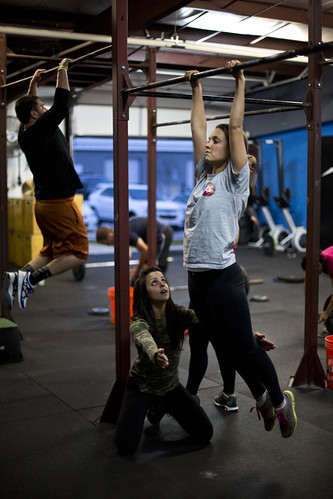
5 Pull-ups
10 Push-ups
20 Air Squats
Each athlete will have 20:00 minutes to complete as many repetitions as possible. The athletes will perform all 5 pull-ups, followed by all 10 push-up, then followed by 20 air squats. Athletes will be placed in two heats and will judge/count each others performance.
Division Options: Rx: As listed D1: Men – Red Band Pull-ups, Women – Red Band Pull-ups and Knee Push-ups D2: Men – Jumping Pull-ups, Women – Jumping Pull-ups and Knee Push-ups
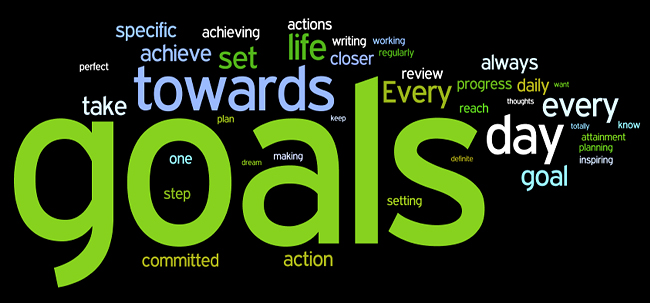
Today the guys are joined by Coach Adrienne for an in depth conversation on setting goals. This is our last podcast of 2013 so enjoy and get started making you goals for 2014!